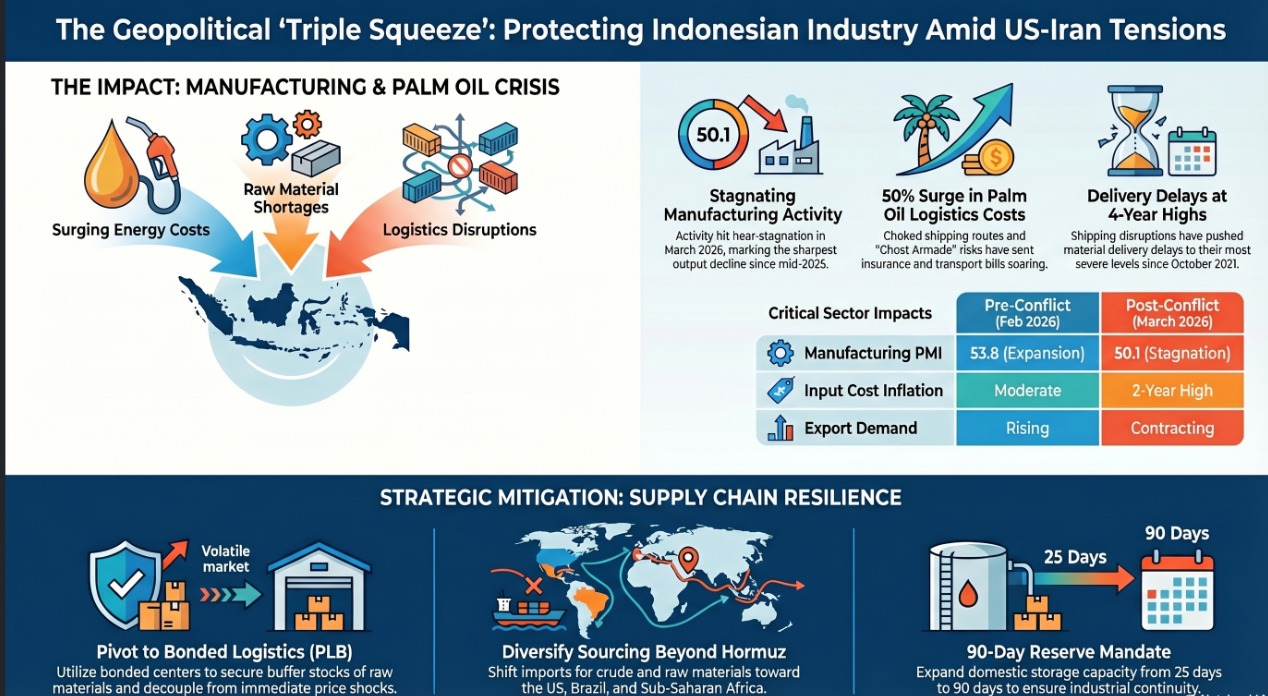
Indonesia’s industrial sector is currently being tested by increasingly uncertain global dynamics. The escalating conflict between the United States and Iran is no longer just international news—it has become a direct operational risk. Data indicates that Indonesia’s Manufacturing Purchasing Managers' Index (PMI) is approaching the stagnation threshold, as markets brace for potential escalation in the Strait of Hormuz.
For industry leaders and CPO exporters, these challenges are tangible: the Rupiah, which weakened to around IDR 17,100 per USD, export logistics costs that risk rising by up to 50%, and growing uncertainty in raw material shipment schedules. Amid rising import costs, operational efficiency is no longer a buzzword—it is a necessity for survival.
Navigating Operational Cost Pressures
One important stabilizing factor is the government’s strong commitment to maintaining domestic energy price stability. To date, the government continues to hold back fuel price increases despite intense global market pressures and currency depreciation. This fiscal shield provides critical breathing room for the manufacturing sector, helping protect production margins from severe erosion.
With relatively stable energy prices, Indonesia’s industrial sector stands on a more solid foundation compared to many neighboring countries that have already implemented significant energy price adjustments. However, relying solely on energy stability is not enough. Industry players must move more agilely in managing uncertainty.
Strategic Industry Actions: Mitigating Risks from Upstream to Downstream
To address global volatility, manufacturing companies and CPO industry players must recalibrate their strategies comprehensively. There is no longer room for minimal inventory management. The following strategic steps are now essential priorities:
1. Transforming Inventory Management
The Just-in-Time model has become increasingly risky amid global supply chain disruptions. Industries need to shift toward stronger buffer stock strategies. Storing raw materials domestically through bonded logistics zones is a logical step to prevent production halts caused by international shipping disruptions or port congestion.
2. Optimizing Cash Flow through Customs Facilities
With currency pressures intensifying, cash flow management is critical. Utilizing facilities that allow the deferral of import duties and taxes is not merely an administrative step—it is a financial strategy to maintain corporate liquidity. Companies with strong compliance standards can access these facilities more easily, ensuring that working capital remains available for core operations.
3. Enhancing Logistics Efficiency in the CPO Sector
For the CPO industry, rising global logistics costs must be balanced with flexible tank storage management. The ability to hold or release stock at the right moment—while maintaining compliance with inspection and survey standards—can determine the difference between profit and loss amid commodity price fluctuations.
Building a Credible Industrial Ecosystem
The key to navigating this period of uncertainty is transparency and credibility. The government continues to streamline bureaucratic processes for companies with proven compliance track records. By maintaining data accuracy, document consistency, and strict adherence to customs regulations, companies not only support national economic stability but also position themselves in the “fast lane” of goods distribution.
Conclusion
Global conditions may be unpredictable, but how risks are managed domestically is entirely within our control. With the support of stable energy prices, strategic inventory management, and optimal use of logistics and customs facilities, Indonesia’s manufacturing sector has a strong opportunity to keep production running smoothly.
Regardless of the challenges emerging from the Strait of Hormuz, companies that are adaptive, disciplined, and strategic will not only survive but thrive amid global uncertainty.