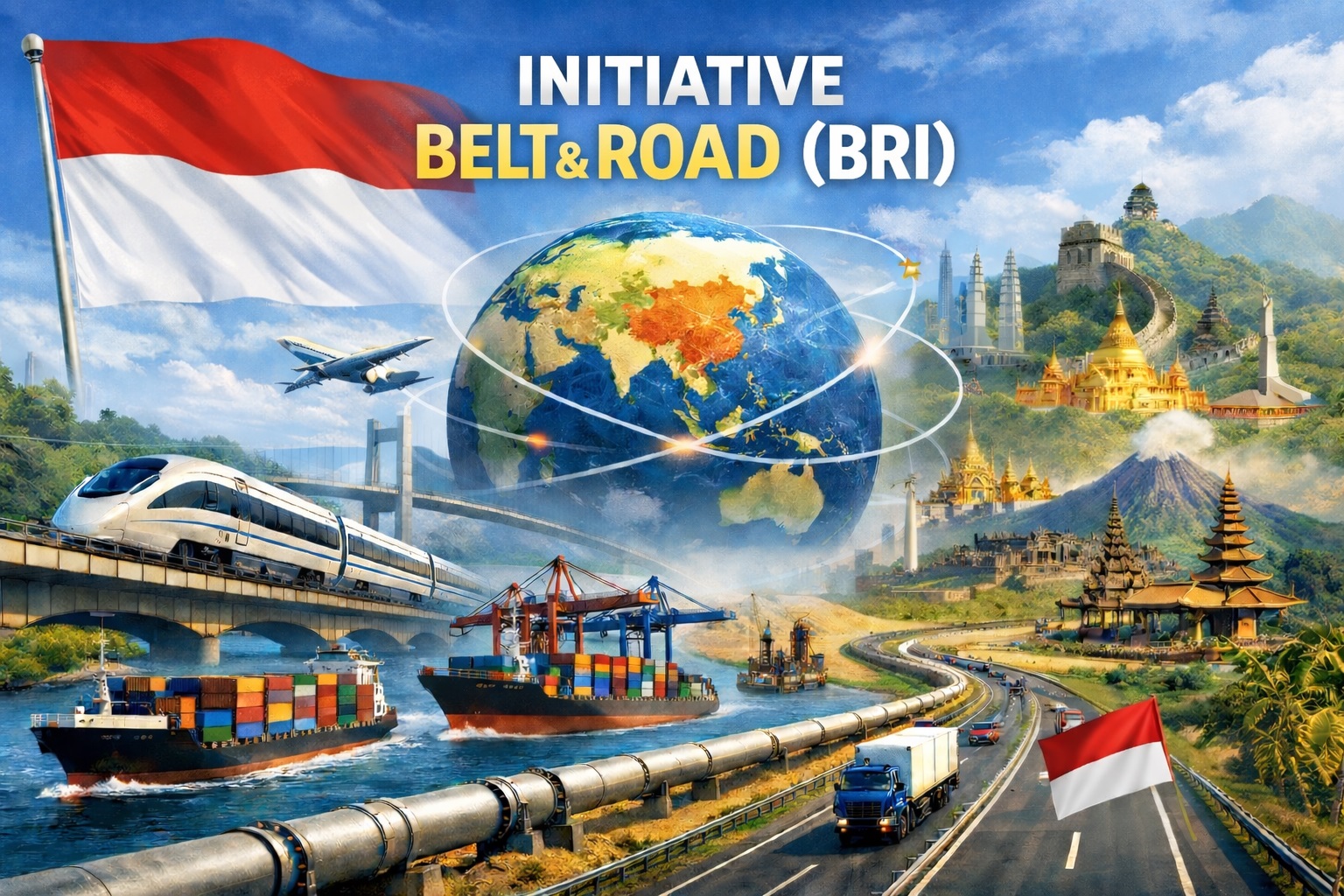
Indonesia at a Crossroads: Turning the Belt & Road Into a Long-Term Trade Advantage
China’s Belt and Road Initiative (BRI) is often discussed in Indonesia through the lens of infrastructure—high-speed rail, ports, industrial zones, and power plants. These projects are important, but they’re not the full story.
The deeper impact of the BRI lies in how it reshapes trade routes, supply chains, and the distribution of economic value across Asia.
For Indonesia, this is a strategic crossroads—a moment to ensure that greater connectivity leads to long-term trade competitiveness, not just higher volumes.
BRI: Reducing Friction, Not Just Building Assets
At its core, the BRI aims to lower frictions within supply chains centered around China by:
-
Shortening delivery times,
-
Reducing logistics and transaction costs,
-
Providing alternative routes to mitigate geopolitical and chokepoint risks.
Even small reductions in time and cost can influence big decisions—where factories are built, where goods are consolidated, and which nations capture higher margins in logistics and manufacturing.
That’s why Southeast Asia’s position has become increasingly strategic.
Southeast Asia and the Changing Geometry of Trade
Global trade is now entering a phase of higher volatility.
Supply chain disruptions, shifting shipping routes, and geopolitical uncertainty are no longer temporary.
In this context, flexibility and redundancy become core advantages.
BRI-driven investments in mainland Southeast Asia—particularly cross-border rail connectivity linking China, Laos, and Thailand—are shaping alternative routes for certain cargo types.
These routes don’t replace sea transport but complement it, especially for time-sensitive semi-finished goods.
As a result, parts of the region are becoming production and consolidation bases near China.
But Indonesia’s position remains structurally distinct.
Indonesia’s Unique Strategic Position
Unlike mainland nations, Indonesia’s strength lies in three pillars:
-
Maritime centrality — Situated along vital Indo-Pacific routes, Indonesia remains an integral part of global sea trade. Port efficiency, domestic distribution, and customs flow reliability are key.
-
Industrial depth and resources — Indonesia’s strength lies in converting natural resources into industrial and energy outputs, giving it leverage beyond transit.
-
Economic scale and domestic market — A large market and growing industrial base allow Indonesia to build an integrated industrial ecosystem—not merely an export platform.
Policies on downstreaming, industrial zones, and customs–logistics reform show clear intent: to elevate Indonesia’s role in the global value chain.
Big Investments ≠ Long-Term Value
BRI has brought significant investment to Indonesia—especially in infrastructure and processing industries.
But globally, size doesn’t always equal sustainability.
The key question is value capture:
-
Who controls the strategic assets?
-
Where are commercial decisions and margins made?
-
How sustainable are fiscal, human capital, and technology benefits?
Indonesia is responding seriously through policy alignment.
The challenge now lies in execution—ensuring the implementation matches intent.
Logistics and Customs as Strategic Assets
In a fragmented trade landscape, execution quality defines competitiveness more than geography.
Leading economies and companies share key traits:
-
Transparent, predictable customs processes,
-
Seamless integration between ports, warehouses, and factories,
-
Digital visibility for inventory and documentation,
-
Flexibility to serve multiple trade blocs.
Indonesia has made strong progress—especially through bonded facilities and digitalization—ensuring that connectivity delivers efficiency, not congestion.
Indonesia at the Crossroads
BRI opens opportunities, but long-term success depends on the strategic decisions made today.
Indonesia’s goal is not just to compete as a transshipment hub, but to position itself as a:
-
Reliable maritime–industrial center,
-
Value-added processing base,
-
Compliant, transparent, and trusted supply chain partner.
The Role of Bonded Logistics Centers (PLB)
In this context, Bonded Logistics Centers (PLB) play a crucial role by enabling businesses to:
-
Defer import duties and taxes for better cashflow,
-
Consolidate, process, and re-export efficiently,
-
Adapt quickly to route and demand shifts.
Amid evolving BRI dynamics and global trade fragmentation, PLBs act as strategic buffers, helping Indonesia serve supply chains that link China, Southeast Asia, and the wider global market.