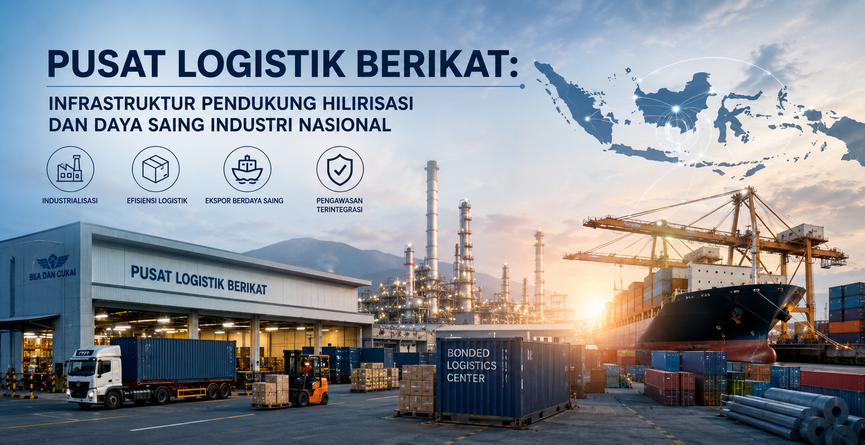
Bonded Logistics Centers: Infrastructure Supporting Downstream Industrialization and National Competitiveness
The Government of Indonesia, under the direction of President Prabowo Subianto and fiscal policy leadership from the Ministry of Finance, has established three pillars of national economic growth: investment, industrialization, and productivity. The downstreaming agenda continues to be reinforced as a core strategy to increase the value-added of Indonesian products in global markets while expanding state revenue from high-value exports.
Within this ecosystem, logistics infrastructure plays a strategic role. One customs instrument specifically designed to support industrialization is the Bonded Logistics Center (PLB)—a facility regulated under Government Regulation No. 32/2009 as amended by PP 85/2015, operating under the direct supervision of the Directorate General of Customs and Excise (DJBC).
The Role of PLB in the Industrial Ecosystem
PLB is a customs area that functions as a storage hub for imported goods as well as domestic goods, offering specific operational flexibilities intended to support industrial activities. It allows industry players to manage raw materials, production components, and operational equipment more efficiently—without compromising customs oversight.
For sectors such as mining, oil and gas, geothermal energy, and export-oriented manufacturing, PLB provides several critical functions:
1. Supporting Production Continuity
Large-scale extractive and manufacturing industries require timely availability of components and equipment. PLB allows strategic inventory storage for up to three years, enabling industries to maintain operational continuity without supply chain disruption.
2. Facilitating National Strategic Projects
Priority projects such as geothermal development, refinery modernization, and smelter construction require specialized, project-based equipment. PLB provides a legal platform to manage such equipment flexibly according to project timelines.
3. Consolidating Downstream Export Products
In accordance with DJBC regulations, PLB can function as a consolidation center for export goods, quality control activities, and integration of finished goods with complementary components. This directly supports the downstreaming agenda—ensuring Indonesian export products leave the country with maximum value-added and competitive strength.
4. Enhancing Customs Efficiency
Import document verification, including compliance with Prohibition and Restriction (LARTAS) provisions, can be conducted within the controlled PLB environment. This improves clearance efficiency while ensuring full regulatory compliance.
Not a Tax-Free Zone — A Supervised Customs Area
It is important to clarify: PLB is not a tax-free zone. It is a supervised customs area operating under strict DJBC oversight, with compliance obligations that are often more rigorous than those applied to conventional warehouses.
Each PLB operator must:
- Operate a real-time inventory tracking system connected to DJBC
- Periodically report all incoming and outgoing goods
- Comply with routine customs audits
- Ensure all goods released from PLB fulfill applicable customs and tax obligations
Therefore, PLB strengthens national trade governance by providing full visibility to authorities over the movement of strategic industrial goods while offering industries the operational space necessary for growth.
Aligned with the Productive Growth Agenda
Within the “survival mode” framework emphasized by Finance Minister Purbaya Yudhi Sadewa—where fiscal policy must contribute directly to state revenue and national competitiveness—the role of PLB becomes increasingly relevant.
PLB is not an instrument that reduces industrial contribution to the state. On the contrary, it acts as an enabler, allowing industries to grow, produce more, and export higher value-added goods—ultimately expanding the national revenue base.
Competitive industries generate larger exports.
Larger exports generate stronger foreign exchange reserves.
Successful downstreaming creates higher domestic value-added.
This is the ecosystem envisioned by government policy, and PLB is one of its supporting instruments.
Conclusion
Productive economic growth, as directed by the government, does not occur in isolation. It requires fiscal infrastructure, regulatory clarity, and logistics systems that reinforce one another.
PLB, as a customs area specifically designed to support industry, plays a concrete role in strengthening the competitiveness of national manufacturing, mining, oil and gas, and geothermal sectors.
For C-level executives designing long-term operational strategies, understanding PLB’s role within the company’s value chain is no longer a technical option—it is part of compliance strategy, efficiency optimization, and contribution to the national development agenda.